
Between June and September, Dubai turns into one of the harshest climates on the planet for human skin. Daytime highs regularly sit between 42 and 45 degrees Celsius, coastal humidity climbs past 80 percent in the early mornings, and the UV Index parks itself at 10 or 11 for weeks on end. Add the constant switching between blast-cold air conditioning and outdoor heat, and your skin barrier takes a beating it never signed up for. The good news: almost every summer skin problem people deal with in the UAE is preventable, and most are treatable if you catch them early.
This guide walks through the eight complaints dermatology clinics across the Emirates see most between May and October, what actually causes them, which home fixes are worth trying, and the point at which you should stop experimenting and book a professional. There is also a short checklist at the end you can save on your phone.
Why Dubai summer is so hard on your skin
The UAE summer is a combination of three stressors your skin rarely faces together anywhere else. First, according to the UAE climate profileJuly and August temperatures often exceed 45 degrees Celsius with recorded peaks above 50. Second, the World Health Organization classes any UV Index above 8 as very highand Dubai sits at 10 to 11 for most of the summer, which means unprotected skin can burn in under 15 minutes. Third, coastal humidity in Dubai and Abu Dhabi routinely rises above 70 percent, while inland cities like Al Ain stay drier but hotter.
Then there is the AC problem. Every time you step from a 25 degree living room into a 44 degree car park, then into a chilled shopping mall, your skin loses moisture and your sweat glands cycle on and off within minutes. If your car windows are not tinted to a legal UAE limit (typically 30 to 50 percent VLT for private cars), UVA rays pass straight through the glass while you drive, which is one of the reasons Dubai dermatologists see so much asymmetric pigmentation on the right side of drivers’ faces.
- Peak UV window: 10 am to 4 pm, avoid direct sun exposure if possible.
- Humidity peak: early morning near the coast, sweat evaporates slowly.
- Indoor risk: AC set below 22 degrees strips barrier lipids fast.
- Car risk: untinted side windows block roughly 25 percent of UVA, meaning most gets through.
The eight skin problems Dubai summer triggers most
These are the complaints that fill dermatology waiting rooms from Jumeirah to Sharjah every summer. Some overlap, and it is common to walk in with two or three at once.
- Heat rash (miliaria). Tiny itchy bumps on the neck, chest, and back, caused by blocked sweat ducts. Very common in babies and in adults who wear synthetic fabrics under the abaya or work uniforms.
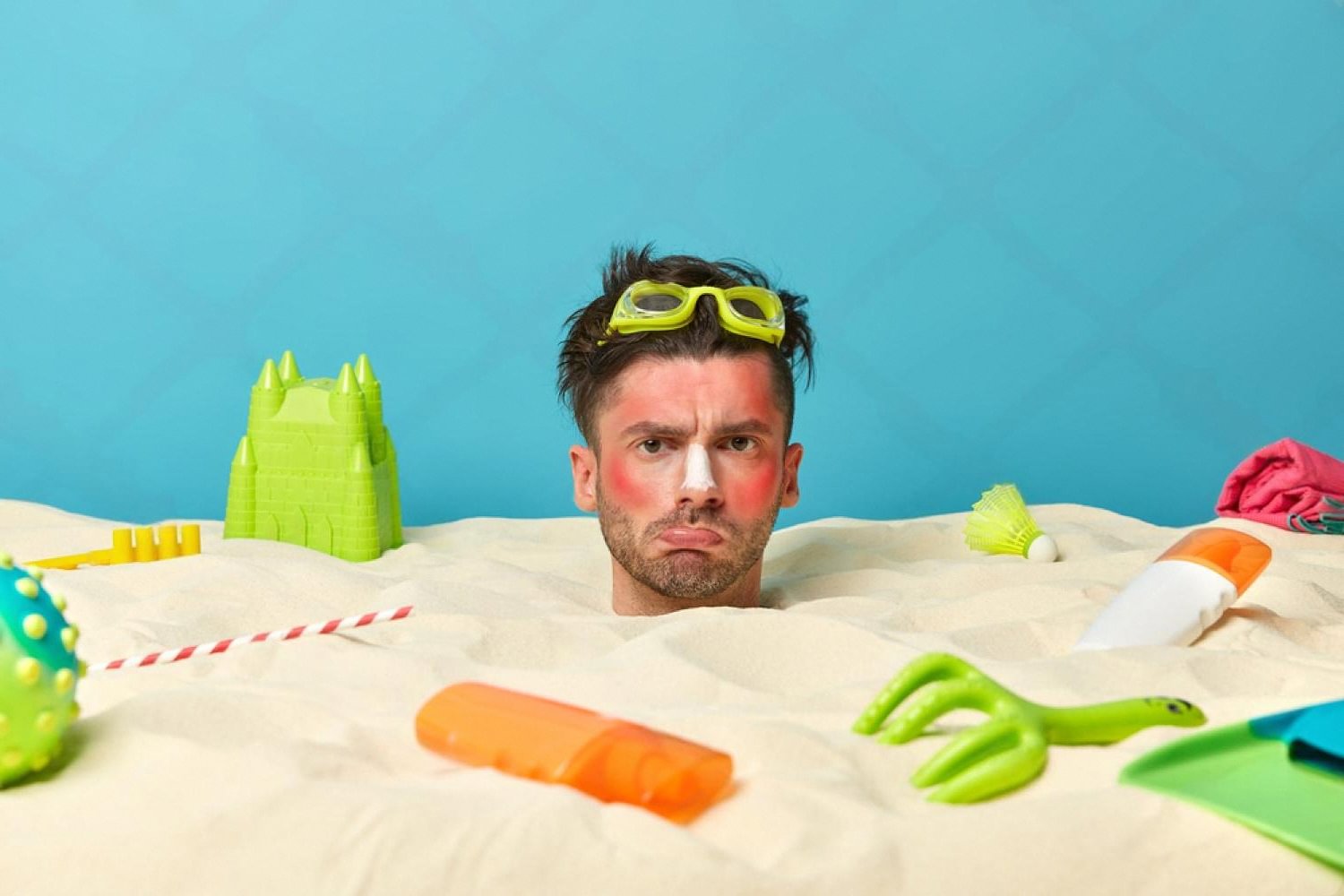
- Sunburn. Red, tender, sometimes peeling skin from UV overexposure. In Dubai, this happens fast: 15 to 20 minutes on the beach at noon without SPF is enough for a first-degree burn.
- Melasma. Brown or grey-brown patches on the cheeks, forehead, and upper lip. Triggered by UV and heat, worsened by hormonal factors. Very persistent in the Gulf climate.
- Fungal infections. Tinea versicolor, athlete’s foot, and groin infections thrive in warm, damp folds. Gym-goers and people who stay in wet swimwear are the usual patients.
- Excessive sweating (hyperhidrosis). Some people sweat far beyond what the heat justifies, especially on palms, soles, and underarms. Summer makes it socially unbearable.
- Dehydration and dryness. Counterintuitive in a humid city, but AC air is bone dry, and dehydrated skin looks dull, feels tight, and shows fine lines more sharply.
- Eczema flare-ups. Chlorinated pools, salty sea water, sweat, and the sudden temperature swings between indoors and outdoors all irritate atopic skin. Kids flare hardest.
- Sweat acne (pityrosporum folliculitis and mechanical acne). Small uniform bumps on the forehead, chest, and back. Not classic acne, and it does not respond to normal acne creams.
Prevention: what actually works in a UAE summer
Daily routine
Build a barrier before you leave the house
Prevention in Dubai is less about expensive products and more about consistency. A basic SPF 50 broad-spectrum sunscreen applied to face, ears, neck, and any exposed skin, reapplied every two hours outdoors, prevents most of the burn and pigmentation problems on this list. Pair it with a lightweight ceramide moisturizer to hold your barrier together against AC dryness.
- Apply sunscreen 20 minutes before going outside, not at the door.
- Reapply every two hours if you are outdoors, or after swimming.
- Drink at least 2.5 to 3 litres of water on days above 40 degrees.
- Tint your car windows to the legal UAE limit for UVA protection.
- Change out of gym clothes and swimwear within 20 minutes.
- Keep AC around 23 to 24 degrees and use a bedroom humidifier.
- Wear loose cotton or linen instead of tight synthetics.
Home remedies vs professional treatment
Not every summer skin issue needs a clinic visit, but knowing where the line sits saves a lot of frustration. Here is how the two approaches compare across the most common problems.
What works at home
- Cool compresses and aloe vera gel for mild sunburn.
- Fragrance-free moisturizer and short lukewarm showers for dryness.
- Loose cotton clothing and calamine for mild heat rash.
- Antifungal powder and dry socks for early tinea pedis.
- Oatmeal baths for mild eczema flares.
- Salicylic acid body wash for early sweat acne.
When to book a dermatologist
- Melasma: needs prescription creams, chemical peels, or laser.
- Sunburn with blistering, fever, or covering large areas.
- Fungal infection that does not clear in two weeks of OTC treatment.
- Eczema flare with cracking, oozing, or infection signs.
- Hyperhidrosis: botulinum toxin injections are the gold standard.
- Persistent sweat acne, folliculitis, or scarring.
The honest rule: if a problem has not improved in 10 to 14 days of consistent home care, or if it is spreading, painful, or leaving marks, stop guessing. Clinics offering aesthetic cosmetology and medical dermatology in Dubai can usually diagnose these conditions in a single visit and start targeted treatment the same day, which is faster and cheaper than months of trial-and-error at the pharmacy.
Professional treatments that actually help
For pigmentation
Prescription tranexamic acid, hydroquinone protocols, gentle chemical peels, and fractional lasers can lift melasma that no cream at home will touch. Results take weeks, not days.
For sweating
Botulinum toxin injections into the underarms, palms, or soles reduce sweating by 70 to 90 percent for four to six months. It is one of the most consistently satisfying summer treatments.
For barrier repair
Hydrating facials, mesotherapy, and prescription ceramide or niacinamide protocols rebuild skin damaged by AC and UV. Best done as short monthly courses through summer.
Your UAE summer skincare checklist
Save this list on your phone. If you hit most of these on most days, you will avoid the majority of problems in this article.
- SPF 50 broad-spectrum sunscreen every morning, reapply every 2 hours outdoors.
- Wide-brim hat and UV-blocking sunglasses when walking outside between 10 am and 4 pm.
- Legal window tint on your car, and long sleeves for long drives.
- Gentle cleanser twice a day, no harsh scrubs during peak summer.
- Lightweight ceramide or hyaluronic acid moisturizer, morning and night.
- 2.5 to 3 litres of water daily, more if you exercise outdoors.
- Change out of sweaty or wet clothes within 20 minutes.
- AC set no lower than 23 degrees, humidifier in the bedroom.
- Loose cotton or linen clothing instead of synthetics.
- Book a dermatologist if any issue persists past two weeks.
Frequently asked questions
How high does the UV Index get in Dubai during summer?
Between May and September, the UV Index in Dubai sits at 10 or 11 almost daily, which the World Health Organization classifies as very high to extreme. At that level, unprotected fair to medium skin can burn in as little as 15 minutes of direct exposure between 10 am and 4 pm.
Can I really get sun damage through my car window in the UAE?
Yes. Standard car glass blocks most UVB but lets a large share of UVA through, and UVA is the wavelength responsible for pigmentation, melasma, and photoaging. Many UAE dermatologists see one-sided pigmentation on the driver’s face, most often the right cheek in right-hand-drive habits or the left in the UAE’s left-hand-drive cars, because of daily commuting.
Tinting your side and rear windows to the legal UAE limit blocks a much larger fraction of UVA and is one of the highest-impact prevention steps you can take.
Why do I break out more in summer even though my skin looks oily?
What looks like ordinary acne in a Dubai summer is often sweat-related folliculitis or heat-triggered breakouts. Sweat, sunscreen residue, and heavy moisturizers can plug hair follicles, and the yeast that normally lives on skin overgrows in warm, damp conditions. This type of breakout does not respond well to standard acne creams and usually needs an antifungal or a switch to lighter, non-comedogenic products.
When should I stop treating melasma at home and see a specialist?
If you have used a good sunscreen consistently and a gentle brightening serum (vitamin C, azelaic acid, or niacinamide) for eight to twelve weeks with no improvement, it is time to see a dermatologist. Melasma in the UAE climate is stubborn because heat itself, not just UV, triggers it. Clinical options like prescription tranexamic acid, tailored peels, and low-energy laser protocols work far better than anything sold over the counter.
Is it safe to use retinol during a Dubai summer?
Yes, but with adjustments. Use retinol only at night, in a lower concentration than you might in winter, and always follow with sunscreen the next morning. If your skin feels irritated, dry, or stings when you sweat, take a break for a week and switch to gentler actives like niacinamide or panthenol until your barrier recovers.
How much water should I actually drink in UAE summer?
Most adults need at least 2.5 to 3 litres per day during peak summer, and more if you exercise outdoors or spend long periods walking between air-conditioned spaces. Watch urine colour: pale straw is fine, dark yellow means you are behind. Adding electrolytes on days above 42 degrees or after heavy sweating is a good idea.
Are children more at risk of summer skin problems in Dubai?
Yes. Children sweat less efficiently than adults, so they overheat faster and develop heat rash easily. Their skin barrier is also thinner, which means sunburn happens quicker and eczema flares harder. Use a mineral (zinc oxide) sunscreen designed for kids, keep them out of direct sun between 11 am and 3 pm, and rinse off chlorine or sea salt as soon as they leave the water.
Do I still need moisturizer if Dubai is humid?
Absolutely. Outdoor humidity does not reach your skin once you step into a chilled office or car. AC air is very dry, and most people in Dubai spend the majority of the day in it. Skipping moisturizer through summer is one of the most common causes of dullness, fine lines, and stinging when you apply sunscreen or actives.